Carla Gerardu-Low | Family Stories & Roots

Uncovering the Stories That Shaped Us

Family Resilience: A Look at the Dutch East Indies in 1942 and the 2020 Pandemic — December 6, 2024

Family Resilience: A Look at the Dutch East Indies in 1942 and the 2020 Pandemic

It’s hard to imagine what it feels like at the beginning of a war. On the island of Java in the Dutch East Indies in January 1942, I imagine there was a tense mix of hope that the danger might pass them by and the growing fear that it wouldn’t.

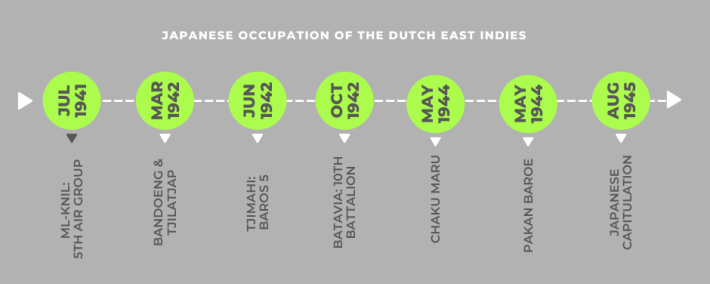
My grandfather (Opa), Johannes H.T. Gerardu, likely didn’t have the luxury of such feelings. As a sergeant in the KNIL (Royal Netherlands East Indies Army), he had a front-row seat to the brewing storm. In December 1941, the Japanese invasion of Southeast Asia was well underway. The Dutch, sensing the threat to their resource-rich colony, declared war on Japan on December 8, 1941, the day after Pearl Harbor. However, the Japanese needed no such declaration to act. They had their eyes set on the Indies’ rubber and oil, and by January 11, 1942, they officially declared war on the Dutch.

Opa was stationed with the 5e Vliegtuggroep (5th air group) at Semplak, a hastily assembled airbase in Buitenzorg (now Bogor). The family lived off-base in a modest house. See my last post, A Mad Scramble to Prepare for the Japanese, to get a feel for where they lived. The map below is an aerial photo of the Palais du Gouverneur-General in Buitenzorg near their home. My dad was 13 years old and attending school at Notaris de Graaf-Stichting, a private secondary school. Life carried on as normally as possible—at least outwardly. But cracks in that normalcy began to show.
Continue reading
Opa’s POW Journey Map — February 4, 2022

Opa’s POW Journey Map

I stumbled upon this awesome tool, StoryMap, to map journeys. It enabled me to take the research I have collected about my grandfather and present it in a sharable format.


The war in the Dutch East Indies was officially underway in early 1942. My grandfather, Johannes Hubertus Theodorus Gerardu (Opa) was a Sergeant in the Royal Netherlands East Indies Army Air Force (ML-KNIL). He was in charge of the kitchen at his base. My father, Servaas, (age 14), remembers Pappy (his father) stopping by the house to tell the family that his unit was moving inland toward Bandoeng (now Bandung). Below is the geographical story of his time as a POW during the Japanese occupation. He was a POW for three and a half very long years.

Continue reading
VJ Day FEPOW’s Gallery (Repost) — August 12, 2021

VJ Day FEPOW’s Gallery (Repost)

This is a repost of a post made on the private Facebook page, VJ Day FEPOW’s Gallery. Other than contributing four photos, I am not the author or administrator of the group. The purpose of this post is to share this amazing project.

Included in the gallery are my grandfather (line 11, 2nd from right), two uncles (last line, 9th & 10th from left), and brother of an uncle (line 23, 4th from right).

Post by Pam Gillespe, Admin, VJ Day FEPOW’s Gallery:

As a tribute to all Far East prisoners of war on this 76th Anniversary of VJ Day, we are pleased to unveil our FEPOW’s Gallery collage.

It contains one thousand photos of those held as prisoners in the Far East, representing the many thousands held overall by the Japanese in camps right across South East Asia during WW2.

Among the one thousand FEPOWs pictured here are many different nationalities including British, Australian, Dutch, American and Canadian. Most are of service personnel of all ranks and all branches of the services, but among the thousand are also civilian internees – men, women and children.

These thousand people were held in locations as far afield as Hong Kong, Sumatra, Java, Borneo, Japan, Thailand, Burma, the Philippines, Singapore, the Spice Islands and elsewhere.

Of these one thousand people, over twenty per cent did not return home.Also included in our one thousand are a number of FEPOWs of whom no photo could be found.

Continue reading
A Pivotal Moment for a Young Soldier — July 3, 2018

A Pivotal Moment for a Young Soldier

My Opa – Johannes Hubertus Theodorus Gerardu

Continuing the story from my previous post – A Very Long Trip – Rotterdam to Tanjung Priok

When someone decides to make a momentous change in location, one must ponder the pros and cons of such a decision. In this case, the pros were the adventure, advancement opportunities, and financial gain, whereas the con was moving away from everything he knew. It is hard to prove what Hubert considered an adventure, but I do have his military record documenting his compensation history, which may give us a peek into this aspect of his life.

J.H. Gerardu ~1921
Johannes Hubertus Theodorus Gerardu in 1921 prior to his departure from the Netherlands to the Dutch Indies

Continue reading

A Very Long Trip – Rotterdam to Tanjung Priok — May 17, 2018

A Very Long Trip – Rotterdam to Tanjung Priok

My Opa – Johannes Hubertus Theodorus Gerardu

Continuing the story from my previous post – 1921: The Decision to Join KNIL

This young Dutchman began a new chapter in his life on March 6, 1921, when he boarded the S.S. Wilis, destination Batavia, Dutch East Indies.

However, before I go there, in an effort to imagine what life was like when he left the Netherlands, I found this video that gives a peek into city life in Groningen. While this is not where Hubert lived, it gives you an idea of what he was leaving behind.

Stamboek Entry: 3/6/1921 Geembarkeered te Rotterdam a.b.as. “Wilis”

Fifty-five days. At sea. In 3rd class or steerage. Now that’s a long trip!

Continue reading

1921: The Decision to Join KNIL — April 16, 2018

1921: The Decision to Join KNIL

My Opa – Johannes Hubertus Theodorus Gerardu

He did it. Even though his father did not want him to. He did it anyway. “What right does he have to have a say in my life?”, he thinks.” He hasn’t acted as a father since I was seven.” That was when his mother died. She was forty-three. As solace, his father turned to the bottle. It must have been too much to bear. How does a man support and raise seven children on his own? Yes, the bottle helped avoid this reality. This wasn’t the way it was supposed to be. Hubert essentially lost his mother, Maria Catharina van Engelshoven (21 Jan 1865, Maastricht, NL) and his father, Servatius Gerardu (29 Jan 1865, Maastricht, NL) that year. It was 1908.

Shortly after the death of his mother, Johannes Hubertus Theodorus Gerardu, better known as Hubert and his two brothers moved in with Servatius’s youngest brother Jos (Hubertus Johannes Josephus Gerardu, 25 Aug 1877). Jos and Elizabeth (Elizabeth van Eijsden, 18 Mar 1878) had five children of their own, so now there were eight. Imagine how loud and crazy it must have been! [Update: Only Hubert went to live with his uncle Jos; one of his younger brothers went to live with another uncle and one to an aunt.]

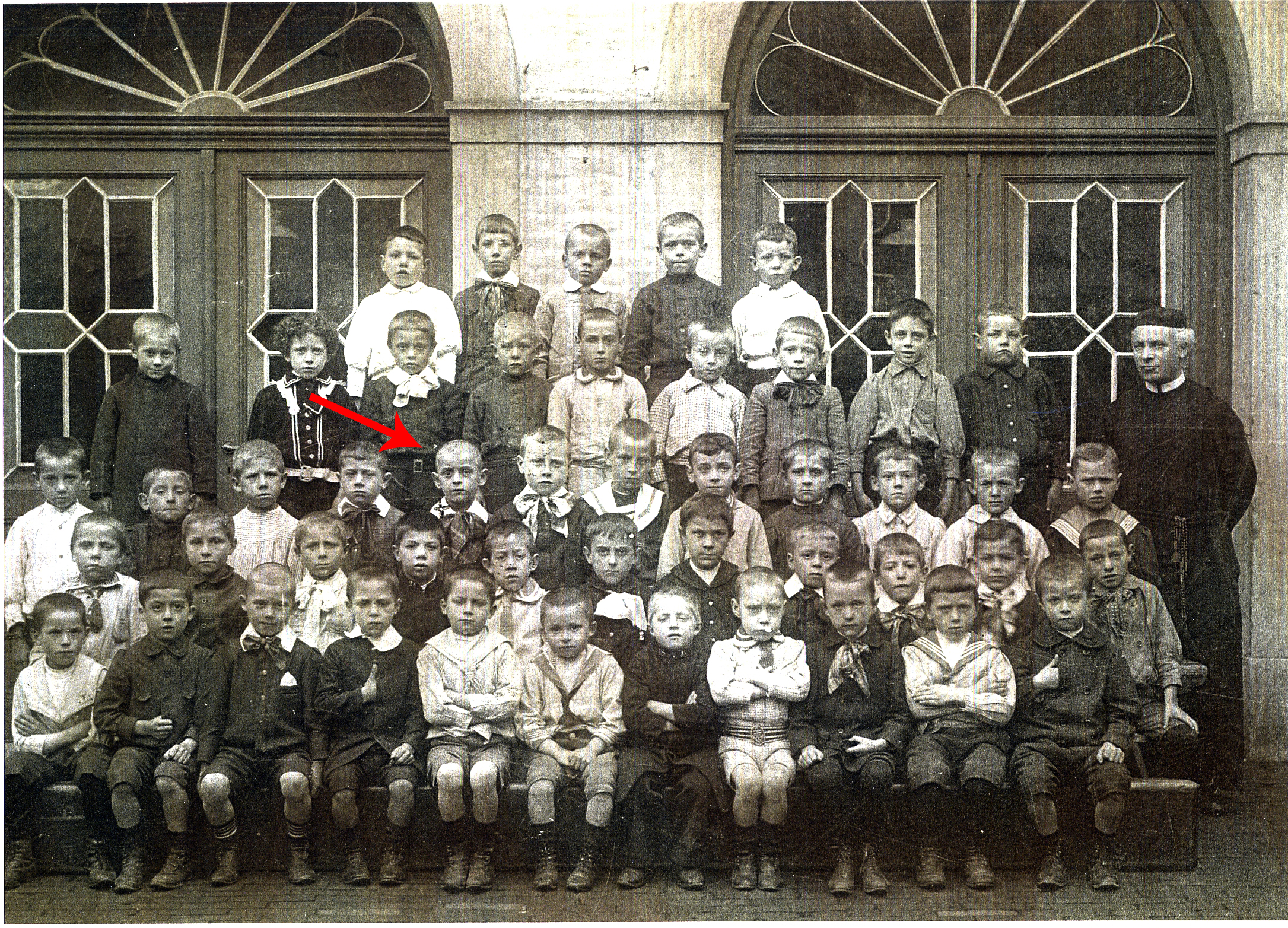
~1909 Class Photo
~1909 Class Photo in Maastricht, NL

Continue reading